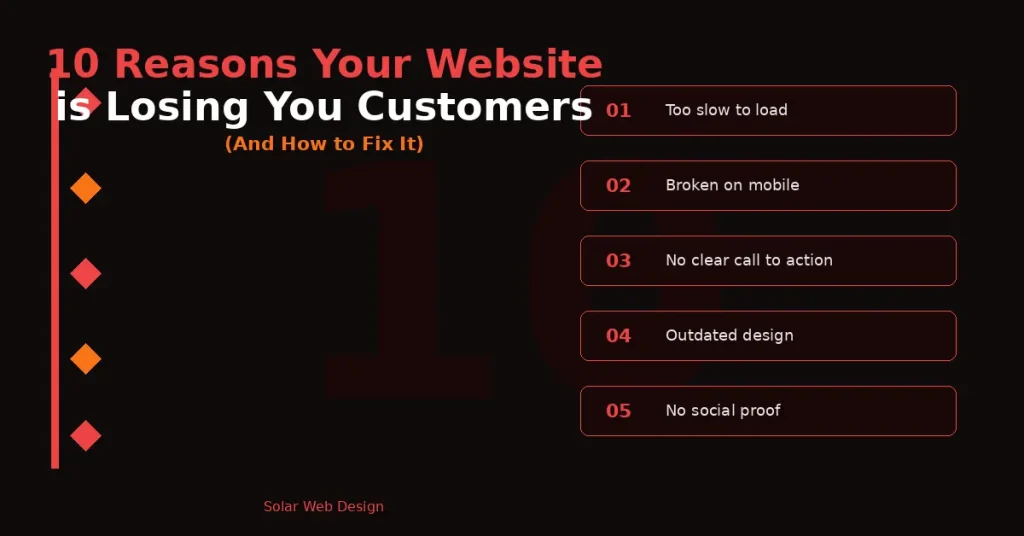
10 Reasons Your Website is Losing You Customers (And How to Fix It)

You have a website. It has been live for a while. But the phone is not ringing the way you hoped it would and the enquiry form is gathering digital dust. Sound familiar?
The frustrating truth is that a website that exists but does not perform can actually be worse than no website at all, because it gives you a false sense of having your bases covered when the reality is that potential customers are landing on your site and leaving without getting in touch.
The good news is that most of the reasons websites fail to convert visitors into customers are fixable. Here are ten of the most common culprits and what you can do about each one.
1. Your Website Loads Too Slowly
Page loading speed is one of the most critical factors in whether a visitor stays on your site or leaves within seconds. Research consistently shows that most people will abandon a website that takes more than 3 seconds to load. On mobile, that tolerance is even lower.
A slow website does not just frustrate visitors. It also ranks lower in Google search results, because Google uses page speed as a ranking factor. So a slow site is costing you both in traffic and in conversions.
Common causes of slow loading speeds include unoptimised images, too many plugins, cheap shared hosting, bloated themes and poor code quality. Addressing these issues can make a dramatic difference to both your user experience and your search engine rankings.
2. It Does Not Work Properly on Mobile
More than half of all web traffic now comes from mobile devices. If your website is difficult to use on a smartphone, with text that is too small to read, buttons that are too close together to tap accurately or layouts that break on a small screen, you are losing a significant proportion of your potential customers before they have even read a word about what you do.
Google also uses mobile-friendliness as a ranking factor. A website that is not optimised for mobile will rank lower in search results than a comparable site that is, which compounds the problem further.
The solution is a mobile first approach to web design, where the site is designed and built with smartphone users as the priority rather than as an afterthought.
3. Your Call to Action is Unclear or Missing
What do you actually want visitors to do when they land on your website? Call you? Fill in a contact form? Request a quote? Book an appointment? If the answer is not immediately obvious from looking at your homepage, you have a problem.
A clear, prominent call to action is one of the single most important elements of any business website. Visitors need to be told what the next step is. Left to figure it out themselves, many will simply leave.
Your call to action should appear above the fold on your homepage, meaning visitors can see it without scrolling. It should be clear, specific and action-oriented. Something like ‘Get a Free Quote Today’ or ‘Call Us Now’ is far more effective than a vague ‘Contact Us’ buried at the bottom of the page.
4. Your Website Looks Outdated
Design trends move quickly, and a website that looked modern five years ago can look noticeably dated today. An outdated website sends a signal to visitors, whether consciously or not, that your business might also be behind the times. In competitive industries, that perception can be enough to send someone to a competitor.
This does not mean you need to redesign your website every year. But if your site still has the hallmarks of a much older era, such as small text, cluttered layouts, stock photography that looks like it is from the early 2010s or a design that does not reflect the current quality of your brand, it is probably time for a refresh.
Read more about the signs it might be time for a redesign on our website redesign page [/services/website-redesign/].
5. Your Content Does Not Answer the Right Questions
When someone lands on your website, they have questions. What exactly do you do? Do you cover my area? How much does it cost? How long does it take? What makes you different from your competitors? If your website does not answer these questions quickly and clearly, visitors will go elsewhere to find a site that does.
Good website content is not about showing off. It is about making it as easy as possible for a potential customer to understand what you offer, whether you are the right fit for them and how to take the next step. Review your website’s content with fresh eyes and ask yourself honestly whether someone who has never heard of your business would come away with clear answers to all of the above.
6. You Have No Social Proof
People trust other people far more than they trust businesses. Customer reviews, testimonials, case studies and before and after photos are some of the most persuasive content you can have on your website, and yet many small business websites have none of them.
If a potential customer is on the fence about whether to contact you or a competitor, a handful of genuine, detailed reviews from real customers in their area can be the deciding factor. Make it a priority to gather reviews and display them prominently on your website. Even three or four good testimonials with names attached can make a meaningful difference to your conversion rate.
7. Your Website is Not Showing Up on Google
All of the above becomes irrelevant if nobody can find your website in the first place. If your site is not appearing on the first page of Google for the searches your customers are making, the vast majority of potential customers will never see it.
SEO is a complex topic, but there are some fundamentals that every small business website should have in place. These include proper page titles and meta descriptions, a logical heading structure on every page, fast loading speeds, mobile-friendliness and content that is genuinely relevant to the keywords your customers are searching for.
If you are not sure where your website currently sits in the search results, try typing the kind of thing your customers would search for and see whether you appear. If you are not on page one, that is a problem worth addressing.
Find out more about how we can help on our SEO services page [/services/seo/].
8. Your Contact Details are Hard to Find
This one sounds obvious, but you would be surprised how many business websites bury their phone number and email address. Your contact details should be easy to find from every page on your website, ideally in the header so they are visible without any scrolling at all.
On mobile in particular, a clickable phone number that allows a visitor to call you with a single tap can make a significant difference to your enquiry rate. If someone has to hunt around to find out how to get in touch with you, many will simply give up and go elsewhere.
A clearly laid out contact page with a simple form, your phone number, your email address and the areas you cover removes every barrier between a potential customer and getting in touch.
9. Your Website Has Not Been Updated in Years
A website with a blog that was last updated in 2021, case studies from three years ago or a team page featuring staff who no longer work for you gives a poor impression. It suggests your business is not particularly active or engaged, which does not inspire confidence in potential customers.
Keeping your website reasonably up to date does not have to be a big job. Adding a new case study when you complete a notable project, updating your services page when your offering changes and refreshing your testimonials section with recent reviews are all relatively quick wins that keep your site feeling current and relevant.
Fresh content also benefits your SEO. Google tends to favour websites that are regularly updated over those that have been left static for long periods.
10. Your Website Does Not Build Trust
Trust is the foundation of every customer relationship, and your website needs to build it quickly. Visitors make judgements about whether they trust a business within seconds of landing on the site. If your website looks unprofessional, has spelling mistakes, uses low quality images or is missing the kind of information customers expect to find, trust evaporates before you have had a chance to make your case.
Building trust through your website involves a combination of things. A professional design. High quality photos of your real work and real team rather than generic stock images. Genuine customer reviews. Clear, well-written content. Visible accreditations and memberships. An SSL certificate so your site loads securely on HTTPS. All of these elements work together to tell visitors that you are a legitimate, credible business worth doing business with.
What Should You Do Next?
If you recognise your website in several of the points above, you have a few options. For minor issues like unclear calls to action or missing contact details, you may be able to make improvements yourself if you have access to edit your site. For more fundamental problems like slow loading speeds, poor mobile optimisation or an outdated design, a professional rebuild is usually the most cost effective long-term solution.
The starting point is always an honest assessment of where your website currently stands. What is it doing well? What is it failing at? What are the priorities? Getting clear on the answers to those questions will help you decide whether targeted improvements or a full redesign is the right next step.
If you think your website might be due for a full redesign, find out more about our website redesign service.
Or if you would like us to take a look at your current site and give you an honest assessment, get in touch with Solar Web Design today. We are always happy to have a conversation with no obligation on either side.